-
-
Neel Sarswoti Marg, Gairidhara-2 Kathmandu
-



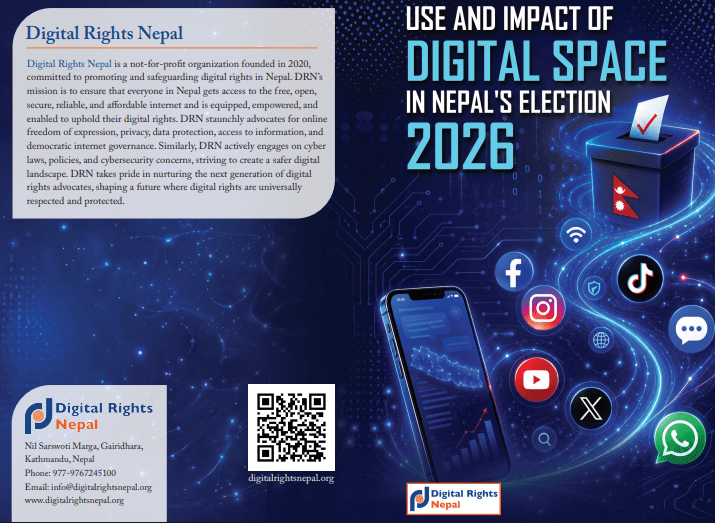
Use and Impact of Digital Space in Nepal’s Election 2026
EXECUTIVE SUMMARY
Nepal’s 2026 House of Representatives Election represented a transformative moment in the country’s democratic journey, characterized by a decisive move from traditional, physical campaigning toward a sophisticated digital-first information ecosystem. Following the 2025 Gen Z-led political movement, the electoral landscape saw the rise of new digital-native political forces. This evolution was underpinned by significant internet penetration, with social media reaching approximately 50% of the population, leading to a hybrid campaigning model where digital outreach became as critical as the physical ballot box.
A major trend observed throughout the cycle was the professionalization and outsourcing of campaign strategies in digital spaces. Traditional materials like posters and banners saw a marked decline whereas political actors turned to professional content creation and management agencies for content creation and micro-targeted messaging. Campaigning shifted from official party-centric narratives to highly personalized, candidate-led digital branding, frequently utilizing podcasts and YouTube. However, this shift also introduced significant opaqueness; many candidates relied on IT fi rms to manage voter outreach and to run SMS campaigns, often with no transparency regarding how voter contact details were accessed or how much was spent on micro-targeted ads.
The integration of technology introduced severe systemic risks, most notably the significant rise of AI-enabled manipulation. Approximately 54% of identified disinformation utilized AI-generated or altered media, with manipulated videos both deepfakes and “cheapfakes” serving as the primary tool for discrediting candidates. Simultaneously, the election highlighted grave privacy vulnerabilities, exemplified by the Election Commission of Nepal’s (ECN) decision to sell digital voter lists containing sensitive information to political parties and the misuse of bulk SMS gateways to send five million unsolicited political messages in a single day. Furthermore, the digital space remained a site of significant Online Gender-Based Violence (OGBV), with female candidates facing a disproportionate intensity of abuse characterized by dehumanizing attacks on their personal lives rather than their political vision.
Institutional responses demonstrated a mix of proactive leadership and significant transparency gaps. While the ECN integrated advanced tools like eMonitor+ to identify nearly 998 instances of “toxic information,” its failure to publicly disclose the nature of the flagged content raised accountability concerns. The election also exposed a growing tension between maintaining electoral integrity and upholding freedom of expression; regulatory actions, such as the suspension of 11 online platforms for opinion polling and attempts to remove international documentaries, were criticized as potentially overbroad and inconsistent approach. Collaboration with tech platforms remained uneven, with TikTok showing proactive engagement through a formal MoU, while Meta had a limited engagement. To strengthen the integrity of future elections, the report emphasizes an urgent need for legislative and institutional reform.
Key recommendations include the enactment of a comprehensive Data Protection Act and updated electoral laws to address the risks posed by generative AI, micro-targeting, and unregulated digital campaign financing. Th e ECN must improve transparency by publishing regular reports on fl agged content, enforcement actions, and referral outcomes, and must reassess its voter datasharing practices to limit the sensitive personal information currently made available to political parties. Finally, moving from ad hoc to standing coordination agreements with major social media platforms, alongside sustained investment in nationwide digital literacy programs, is essential to protect the democratic process from synthetic media and coordinated manipulation.
Recent Report 
-

15 July 2026
Vacancy For Social Media Monitors
-
16 March 2026
Nepal Election Monitoring| Ep 10
-
09 March 2026
Nepal Election Monitoring| Ep 09
-
28 February 2026
Nepal Election Monitoring| Ep 08
Digital Rights Nepal is a not-for-profit initiative dedicated to the protection and promotion of digital rights in Nepal.